




Let us help you get your project done
We’re excited to hear your project.
Let’s collaborate!
Not sure? Call us (416) 243-2431.

Choosing the wrong CMS for a healthcare website is a financial and compliance risk.
Healthcare data breaches cost an average of $10.93 million per incident in 2023, the highest of any industry for the 13th consecutive year. At the same time, ADA website accessibility lawsuits against healthcare organizations are accelerating, with over 2,000 filed in the first half of 2025 alone. Add to that the fact that 76% of patients now expect digital options when interacting with providers, and the pressure to get your web infrastructure right has never been higher.
We’ve put together this comparison guide to help you take an informed decision and avoid the potential consequences of choosing the wrong CMS for your healthcare website.
At OPTASY, we have spent years helping healthcare organizations navigate the complexity of enterprise CMS selection, implementation, and long-term maintenance. We understand that healthcare websites carry requirements that general-purpose agencies are not equipped to handle (HIPAA-aligned architecture, accessible design baked into every component, multi-location content governance, and integrations with EHR and patient portal systems.)
Our team specializes in Drupal, the platform trusted by Mayo Clinic, the CDC, Penn Medicine, and Stanford Health Care, among many others. Whether you are evaluating platforms for the first time, considering a migration, or managing a legacy
Sitecore environment that has become difficult to maintain, we can help you make a clear-eyed decision that balances compliance, cost, and long-term flexibility.
Contact us today to learn more about how OPTASY can help.
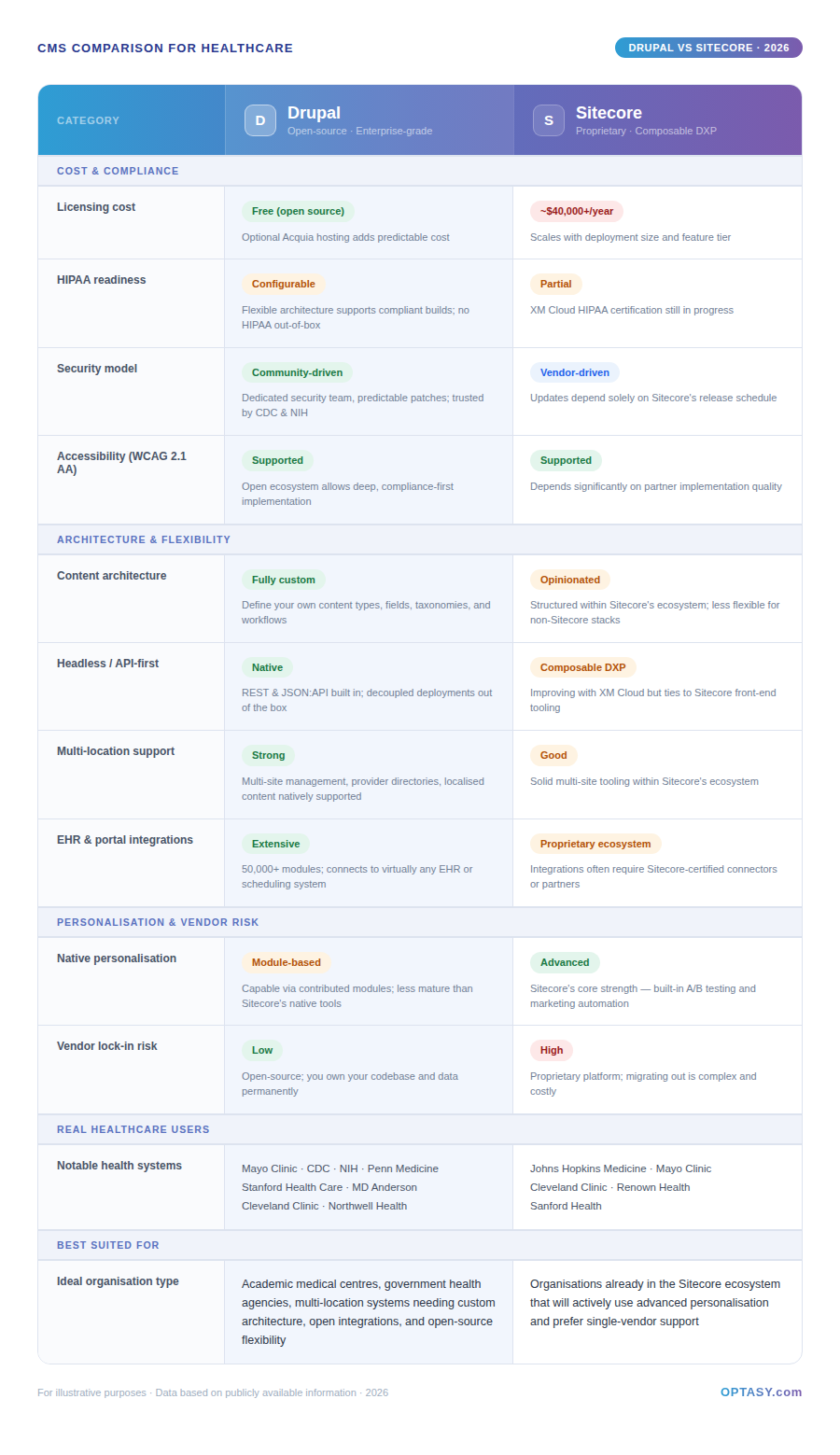
Both Drupal and Sitecore have earned their place at the top of the healthcare CMS market.
According to MarTech.Health's analysis of the top-ranked U.S. hospital systems, Drupal/Acquia and Sitecore have the most impressive healthcare customer lists of any CMS platform. This is not a comparison between a market leader and an underdog but a choice between two enterprise-grade platforms with meaningfully different philosophies.
Understanding where each excels, and where each falls short, is how healthcare IT leaders make a decision they will not regret three years later.
Security is the non-negotiable starting point for any healthcare CMS evaluation.
60% of healthcare survey respondents ranked cybersecurity as their top concern for 2025, and the proposed 2025 HIPAA Security Rule update is tightening requirements further. It has eliminated the distinction between "addressable" and "required" controls, mandating encryption of all ePHI at rest and in transit, and requiring vulnerability scans every six months.
Drupal handles security through a configurable, layered architecture.
Role-based access controls are granular and flexible. The Drupal Security Team issues patches on a predictable schedule, and the platform's adoption by the CDC, NIH, and multiple federal health agencies provides real-world validation that the security model holds up under institutional scrutiny. Drupal does not come with HIPAA compliance out of the box (no CMS does) but its architecture makes compliant configuration straightforward for experienced developers. You can also further strengthen your Drupal environment by selecting the right security modules and following established Drupal security best practices.
Sitecore has been working toward HIPAA certification for its cloud-based XM Cloud offering, though that certification remains incomplete at the time of writing. Its enterprise access controls are robust, and the platform has strong support for the kind of multi-team governance workflows healthcare organizations require.
However, the proprietary nature of the platform means security updates depend entirely on Sitecore's release cycle, with less community-driven detection than Drupal's open-source model provides.
For healthcare organizations managing large volumes of patient-facing content and increasingly scrutinized for their use of web tracking technologies, Drupal's configurable, transparent architecture provides a stronger foundation for HIPAA-aligned compliance.
This is where the comparison becomes stark.
Drupal is open-source, meaning the core software carries no licensing fee. Sitecore is proprietary, with enterprise licensing costs typically starting around $40,000 per year and scaling significantly for larger deployments.
That licensing gap compounds over time. A five-year Sitecore engagement can represent $200,000 or more in platform costs before a single line of development work is written. For healthcare organizations already operating under pressure with IT budgets averaging less than 5% of net patient revenue, that is a meaningful number.
Drupal organizations can optionally layer Acquia's enterprise hosting and support platform on top of the open-source core, which adds cost but remains substantially more affordable than Sitecore licensing at comparable scale. The open-source model also means no vendor lock-in: your codebase, your data, your future.
Sitecore's cost is partly justified by its out-of-the-box personalization and marketing automation tooling, which is genuinely more mature than Drupal's native equivalent. For organizations that will actively use those features, the calculus changes. For those that primarily need a secure, scalable, compliant content platform, the licensing premium is harder to defend.
Healthcare websites are not simple.
A regional health system might manage dozens of service line pages, hundreds of physician profiles, multiple campus locations, urgent care and emergency department listings, patient portal integrations, and a blog. All of this is under a single CMS instance, all with different content workflows, different approval chains, and different compliance requirements.
Drupal was built for exactly this kind of structural complexity.
Its content architecture is entirely custom. You define your content types, your fields, your taxonomies, and your workflows from the ground up.
With over 50,000 contributed modules, Drupal can integrate with virtually any EHR, scheduling system, or patient portal. Its
API-first architecture means content can be delivered simultaneously to a website, a mobile app, a patient kiosk, and a wearable device from a single source of truth, which makes it a natural fit for the kind of omnichannel patient experiences that modern healthcare organizations are building.
Sitecore approaches content architecture differently, with a more opinionated structure that works well within its ecosystem but can become limiting when healthcare organizations need to connect to non-Sitecore systems.
Its composable DXP approach is evolving, and XM Cloud represents a genuine step forward. But implementation complexity remains high, and organizations often find themselves dependent on Sitecore-certified partners for even routine configuration changes.
For multi-location health systems managing provider directories, which is a known pain point that costs the U.S. healthcare industry $2.76 billion annually in inaccuracy and manual upkeep, Drupal's flexible content modeling and Views module provide a powerful, maintainable solution.
The legal exposure from inaccessible healthcare websites is growing rapidly.
The DOJ's Title II rule requires WCAG 2.1 Level AA compliance for government-affiliated healthcare sites by April 2026, and private healthcare organizations face immediate lawsuit risk with no grace period.
Critically, 22.6% of accessibility lawsuits in 2025 targeted sites that already had overlay widgets installed, which means bolt-on fixes do not protect organizations the way a compliance-first build does.
Both Drupal and Sitecore support accessible development practices, but neither delivers accessibility automatically.
The difference lies in how accessible themes, structured content models, and editorial workflow checks are implemented, and that is largely a function of the development partner, not the platform itself.
Drupal's open ecosystem gives experienced partners more flexibility to build accessibility into every layer of the content creation process, rather than relying on proprietary components that may not meet WCAG requirements.
This is especially important for healthcare organizations building secure and compliant Drupal websites where accessibility cannot be an afterthought.
Healthcare organizations are increasingly delivering content across more than just a website.
Patient portals, mobile apps, telehealth platforms, and digital signage all benefit from a single content source that can feed multiple front-end experiences. The patient portal market alone is projected to reach $18–24 billion by 2033, driven by demand for connected, seamless digital health experiences.
Drupal's API-first architecture makes it a natural fit for decoupled and headless deployments. Content editors manage everything in one place, and developers use Drupal's robust REST and JSON:API layers to power whatever front-end experience is needed.
Sitecore's composable architecture offers a comparable vision, though the implementation is more tightly coupled to Sitecore's proprietary front-end tooling, which can limit flexibility when working with existing technology stacks.
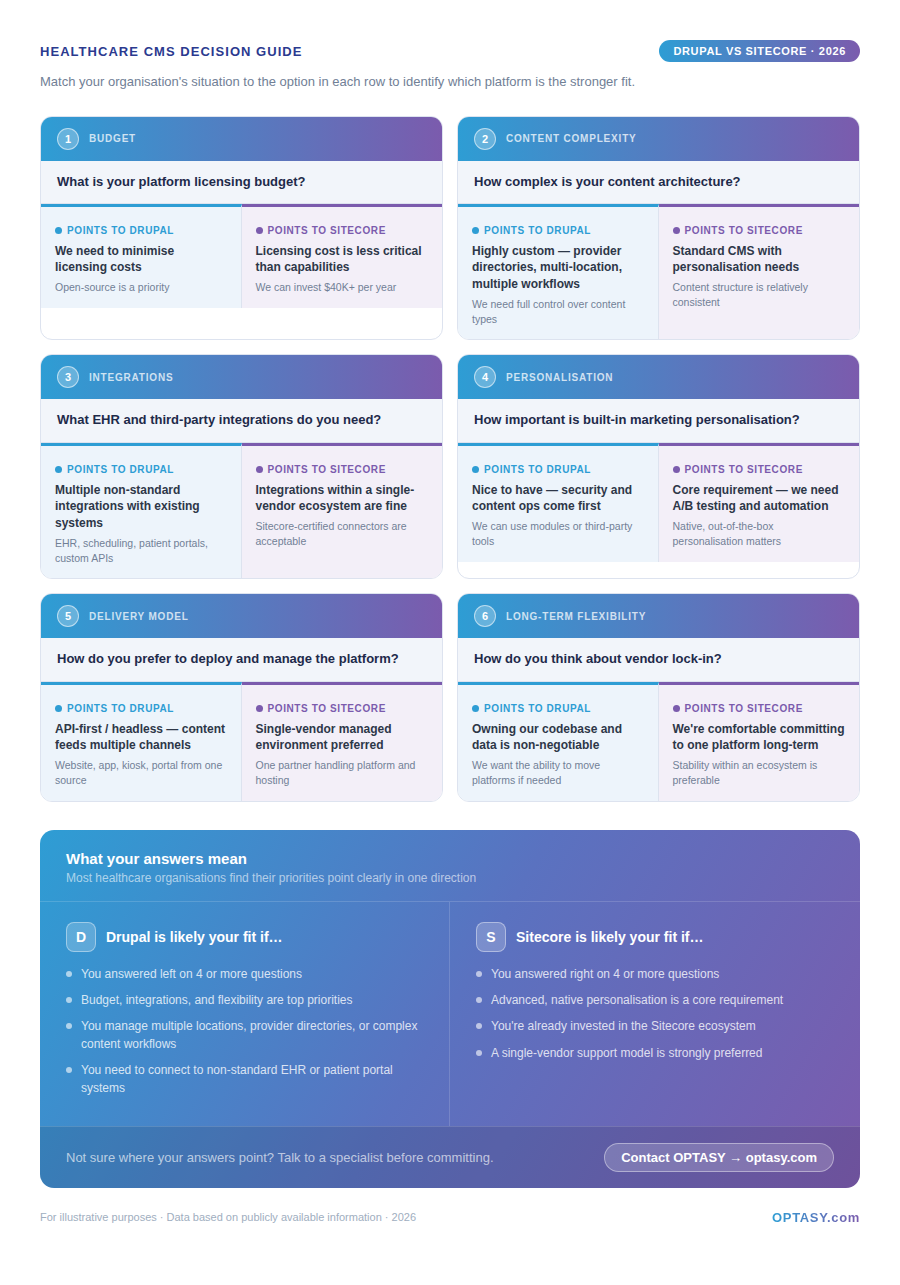
There is no universal answer, but there are clear patterns.
Drupal tends to be the stronger choice for healthcare organizations that need deep content customization, multi-location architecture, open-source flexibility, and enterprise security without enterprise licensing costs.
It is the platform of choice for academic medical centers, government health agencies, and organizations with complex integration requirements.
If you are evaluating Drupal against other platforms, our comparison of Drupal vs WordPress for healthcare websites and our broader guide to choosing the right CMS for healthcare are useful additional resources.
Sitecore tends to be the stronger choice for organizations that will heavily leverage its native personalization and marketing automation tools, have already invested in the Sitecore ecosystem, or are operating in environments where a single-vendor support model is preferred over community-backed open-source.
For most regional and national health systems weighing the two for the first time, Drupal's combination of zero licensing cost, proven healthcare adoption, and architectural flexibility represents the stronger long-term investment, particularly as HIPAA enforcement tightens and accessibility litigation accelerates.
The stakes of a CMS decision in healthcare are higher than in most industries.
Security vulnerabilities, accessibility gaps, and compliance failures carry legal, financial, and reputational consequences that extend well beyond a website redesign budget.
The right platform, implemented correctly, becomes the infrastructure that enables better patient experiences, more efficient content operations, and a defensible compliance posture for years to come.
OPTASY has the Drupal expertise and healthcare industry knowledge to guide your organization through this decision and to build the right solution once you have made it.
Contact us today to discuss your healthcare website requirements.
We’re excited to hear your project.
Let’s collaborate!