




Let us help you get your project done
We’re excited to hear your project.
Let’s collaborate!
Not sure? Call us (416) 243-2431.

AI adoption inside enterprise content teams has crossed a threshold that most governance frameworks haven't caught up with yet.
The gap is widening fast: a large majority of enterprise marketing teams are now using generative AI for content production, while fewer than 30% have formal policies to manage it. MIT research puts factual errors in AI-generated content somewhere between 15 and 20%.
For organizations running complex, regulated, or high-traffic web properties, that combination of speed and insufficient oversight creates a real compliance and content quality problem. Drupal CMS 2.0, launched on January 28, 2026, was built with that gap in mind.
In this article, we look at how Drupal CMS 2.0 responds to that gap, what it actually shipped, what's on the 2026 roadmap, and what it means for content teams trying to adopt AI without introducing new compliance risks.
Most organizations that decide to adopt Drupal's AI capabilities hit the same wall: the features exist, but getting them production-ready takes real configuration work.
OPTASY has been building Drupal sites for over 18 years, and is one of the official Drupal AI contributing partners. That means the team working on your implementation has been part of building the direction it's heading.
Connecting your AI provider (OpenAI, Anthropic, Google Gemini, or a self-hosted model) is far from a one-click process. Neither is configuring the review workflows that sit between AI output and your live site, or planning around the background agent capabilities arriving later in 2026. These are implementation decisions that shape how the tools actually perform, and getting them wrong early is annoying to fix later.
OPTASY handles that groundwork so your team can focus on what the tools produce. If you're evaluating whether Drupal's AI features fit your workflows and compliance requirements, the earlier you start that conversation, the better.
Drupal CMS 2.0 is the first version of the platform to ship with AI built in by default, not bolted on as a separate module stack. The change shows up in three concrete places.
Site builders can now interact with the CMS through plain language instead of navigating configuration menus. Creating a content type, adding fields, defining taxonomy terms — type the request, the chatbot handles it.
For development teams managing multiple builds or frequent structural changes, this cuts setup time considerably. You can still review and adjust what is configured. The chatbot doesn't get the final word.
This is probably the most immediately useful addition for editorial teams. The module uses computer vision to analyze uploaded images and write descriptive alternative text automatically, with multilingual output based on the entity's language setting. Missing alt text is one of the most common WCAG failures on enterprise sites. It's also, now, one of the easiest things to stop doing manually.
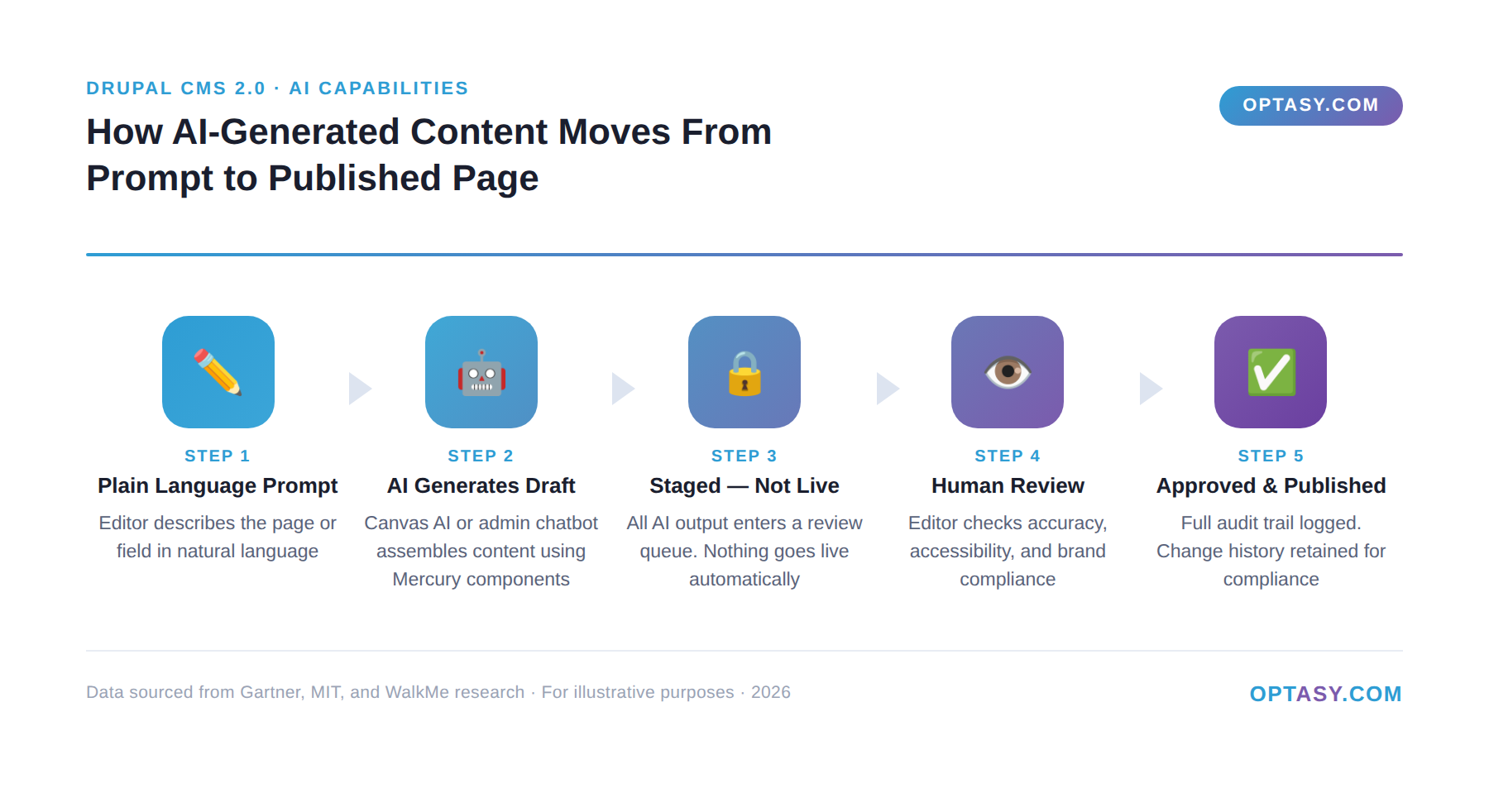
Canvas is Drupal's visual page builder. The AI version extends it: you just describe a page in plain language, Canvas AI builds a fully structured page using Mercury components. What doesn't happen is just as important, which is that nothing gets pushed live automatically. Every AI-generated change waits in a review queue until a human approves it.
That design choice matters more than it first looks.
Most AI tools push output directly to wherever you're working. Drupal's approach is different: AI-generated changes go into a staging queue, and a human approves them before anything hits the live site.
For teams in healthcare, government, financial services, or higher education, this workflow improves compliance. Given that AI-generated content carries factual errors 15–20% of the time, a review layer is a practical compliance requirement whether or not it's formally mandated. Publishing an incorrect clinical claim or an accessibility-violating page because an AI tool skipped review is the kind of problem that gets explained after the fact.
The architecture is also provider-neutral. CMS 2.0 supports OpenAI, Anthropic (Claude), Google Gemini, and self-hosted open-source models out of the box. Organizations with data residency requirements or concerns about vendor lock-in can route AI requests through their own systems. That's not common in the CMS market, and it's directly relevant for government and healthcare clients who can't always send content data to third-party cloud services.
CMS 2.0 is the starting point. Drupal's 2026 AI roadmap, backed by 28 organizations pledging more than 23 full-time equivalent contributors, outlines eight capability areas under active development this year.
The most consequential is background agents. Instead of waiting for a prompt, a background agent monitors content on its own, flagging outdated articles, updating structured fields when related content changes, responding to scheduled triggers. If you're the kind of person who finds it slightly unnerving to think about AI running tasks while nobody's watching, Drupal's audit trail requirements are clearly a response to that instinct.
Other roadmap items include advanced governance tooling with batch approval workflows, branch-based content versioning, and full change logs for AI-generated edits. Multi-channel campaign management would let teams produce content for a website, email, and social from a single brief. And "intelligent website improvements" would have AI learning from performance data and proposing specific changes for editorial sign-off, not generic suggestions, actual proposed edits.
The stated long-term goal is expanding Drupal's AI agents to over 30 distinct functions, with the roadmap describing an AI-first CMS as the end state.
The business case is holding.
68% of businesses report higher content marketing ROI from AI use, and organizations that adopted generative AI early now report $3.70 in value for every dollar invested. But those numbers assume the AI is running inside a consistent system, not scattered across five different tools that don't talk to each other.
That's the problem most content teams are actually dealing with. Standalone writing tools, browser plugins, disconnected chatbots, content produced outside the CMS doesn't go through accessibility checks, doesn't match brand taxonomy, leaves no audit trail. When multiple contributors are involved, it compounds.
Drupal treats AI as part of the editorial workflow.
For content editors that means fewer manual tasks on repetitive structured work: field population, alt text, taxonomy assignment. For developers it means faster configuration of new content structures. Content strategists get an AI module that analyzes the existing site and recommends new article topics, which is useful for teams managing large libraries who don't want to run that audit by hand. And for leadership, AI adoption fits within existing governance frameworks rather than requiring a new policy stack built around a separate set of tools.
Drupal has long been the platform of choice for organizations where "good enough" isn't. The AI features in CMS 2.0 extend that character into an area where most platforms are still working out the governance side. The foundation is live now. If your organization wants to figure out how Drupal's AI capabilities fit your specific workflows, talk to OPTASY. We've been on this platform long enough and we'll help you build it the right way.
We’re excited to hear your project.
Let’s collaborate!